Signed in as:
filler@godaddy.com
French Bulldogs are beloved companions known for their charming personalities and distinctive appearance. However, like many brachycephalic breeds, they are prone to certain genetic and structural health issues. Responsible breeding and ownership start with thorough health testing to identify potential problems early, improve breed health, and ensure the well-being of individual dogs. This guide explores the essential genetic tests and Orthopedic Foundation for Animals (OFA) certifications for French Bulldogs, providing breeders, owners, and enthusiasts with the knowledge to make informed decisions.
The following information has been adapted from the blog posted at Crowd Pleazer Frenchies: "Guide to Health Testing Your French Bulldog: Genetic & OFA"

Guide to Health Testing Your French Bulldog: Genetic & OFA

Health Testing your breeding stock is an important part of being an ethical breeder. There are few things worse than a puppy, especially one sold to a hopeful pet home, who is then diagnosed with a genetic disease or heart condition that could have been prevented.
Today's breeders have far more tools available to them than in past decades and a simple cheek swab can reveal whether or not your foundation stock are carriers of a disease or physical condition that can be managed upfront, BEFORE they are bred.
This doesn't mean they can't be suitable for breeding, but that as a breeder it is up to you to carefully select their partners.
Also, having two copies of a genetic marker doesn’t automatically mean the dog will develop a disease.

Think of it like skipping your annual physical exam because you ran a 23ANDME or Ancestry.com test. They are NOT the same thing.
While testing for genetic markers linked to disease are an important part of health testing, they are not the complete picture.
Genetic markers give insight to risk of developing a disease, but do not give insight to phenotypical diseases, such as hip and joint health, spines, hearts, eyes, etc. Further, the number of known markers for French Bulldogs is not fully mapped and is therefore incomplete.
This is why ethical breeders screen their breeding stock for BOTH genetic and phenotypic diseases.

That said, it is important to acknowledge that health testing is a “Breeding Tool“, not solely a “Marketing Tool”. Of course, you want to highlight your dog’s clear health and you should definitely shout it out.
Nothing wrong with that!
It is especially important when you see "OFA Certified" in a post to better understand what’s behind the statement, which CAN be misleading. It can mean something like having one or two certifications for something like the basic physical exam for heart and patellas (which most FBDs pass easily) or something more in-depth such as the hips, trachea, elbows, and spine.
All of those are indeed certifications, but to imply that a dog that's only certified for basic heart (not echocardiogram) and patellas is the same as a dog that's been tested for OFA CHIC is definitely not the same. And to be direct: ALL health testing should be encouraged and applauded.
Just know that a blanket "OFA certified" does not mean sometimes what the posting owner might imply, especially if followed by a bunch of fire emojis 🔥 🔥 🔥
There's currently no cert for that... just saying.
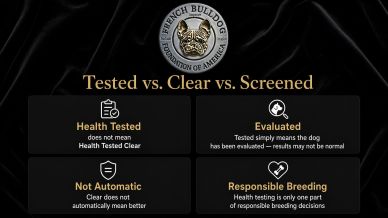
Make sure you know the difference between a statement like "Health Tested" vs. "Health Tested Clear". One statement means the dog has actually been tested (kudos) and that's awesome. But make sure to ask what the results were... tested doesn't mean Clear. And when it comes to phenotype tests, CHIC means tested, but not necessarily "normal".
Trust, but verify.
Clear Doesn't Mean "Better"
Everyone wants to have a clear "report card", right? Except with French Bulldogs, the test results do not always have to be perfect or clear, nor does having a health-tested clear dog mean that they are also suitable breeding stock. Health testing is simply part of the whole picture of deciding which dogs should or should not be bred vs. those who are suitable and then a smart breeder will use this information to then assess structure, disposition, color, and other traits to make an informed decision. J
Just because a dog has a slightly better hip rating, or fewer "marks" on their spine X-ray doesn't automatically make that dog better than another. Health needs to be evaluated as an entire system in combination with what the dog brings as a whole to the French Bulldog Breed.
You can have a health-tested clear "donkey" that does not meet French Bulldog breed standards.
.png/:/rs=w:388,cg:true,m)
Nor should you automatically "trust" that someone dangling "Breeder of Merit" actually kept their promise to AKC and did their mandatory health testing.
Many only have the show ring ribbons and no verifiable health tests, even those on the parent club's referral page despite their claim to require their list to perform CHIC tests on both parents.
If they did, the OFA database would certainly have more than 4,800 hip test results reported in over 26 years on a breed that now has over 75K registrations each year.
Instead, consider a breeder from the AKC Breeder with H.E.A.R.T. program, focused on Health, not Show Ring egos and satin.
Health testing is not just a recommendation—it's a cornerstone of ethical breeding. French Bulldogs face hereditary conditions that can affect their quality of life, from respiratory issues to orthopedic problems. By testing, breeders can:
Testing combines genetic screening (DNA-based) with phenotypic evaluations (physical exams like OFA). Together, they offer a complete picture. According to the French Bulldog Club of America (FBDCA) and AKC, breeders should prioritize tests for common issues like brachycephalic syndrome, spinal abnormalities, and inherited diseases.
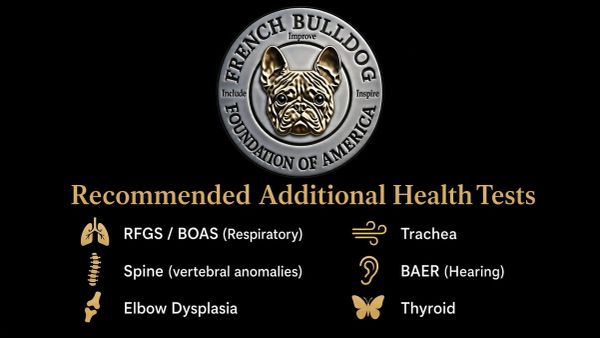
The Orthopedic Foundation for Animals (OFA) provides certifications based on physical exams and x-rays to assess structural health. For French Bulldogs, focus on breed-specific issues like hips and respiration.

Recommendation: OFA CHIC for breeding dogs. Cost: $35-200 per test; submit to OFA.org for certification.

You may have seen a lot of discussion about being Four, Five, or Six Panel tested. Some people even report 187+ clear. But what exactly does that mean?
It can actually mean a lot of different things and it's very important to ask exactly what panel is being referenced. More than once I've seen someone post "Five Panel Clear", but the test was performed by VGL, which only offers either four-panel or six-panel, meaning that the dog wasn't clear on one of the six (CDDY).
To make it more confusing, Animal Genetics has a Five Panel test, but it's testing something entirely different than what a lot of breeders are referencing when they say "Five Panel" because they want to let you know their dog is tested for Cystinuria 3 (C3).
The test for C3 something fairly new that is not included in most routine panels (yet) and is usually purchased a'la carte, especially if the owner already purchased health testing for the other tests prior. Since it isn't really readily available in a packaged "panel" it is often referenced separately. If you don't see it called out, it probably hasn't been tested, or... the dog isn't clear. You need to ask.
*Genetic testing uses DNA samples (cheek swab or blood) to detect mutations linked to diseases. For French Bulldogs, labs like Embark, UC Davis VGL, Animal Genetics, Orivet, and Paw Print Genetics offer breed-specific panels.
The "Panel Clear" refers to testing negative (clear) for all conditions in the panel, but there is little consistency between what IS and IS NOT on the French Bulldog "panel".
For example, screens for Degenerative Myelopathy, PRA-CRD4, CDDY (IVDD) are often included in the commercial lab packages but they are publicly stated for OFA themselves as being irrelevant markers for the French Bulldog breed. This reporting policy can cause great confusion and concern, both for breeders testing their dogs with due diligence, and for pet home owners who ask for test results of the puppy they are bringing home.
*See Dr. Jerold Bell's analysis of the irrelevancy of the marker for DM in French Bulldogs.

This basic panel screens for four common conditions:
In general, the "classic" French Bulldog DNA Health Panel is usually referring to the following four tests: JHC, CMR1, HUU, and DM*. This is considered the BASIC entry-level test and while your puppy doesn't need to be clear of all copies of these genes, you definitely don't want to have two copies of the same disease*.
If the breeder hasn't tested the actual puppy or litter, they should at the very least be able to show you clearance by parentage (it's not that hard).

An expanded panel adding two more:
French Bulldog Six Panel DNA Health Test
This test is offered by VGL and is sold as "French Bulldog Test 1". It is exactly like the four panel (and even the same price) but includes two tests that are fairly new and somewhat controversial:
The reason for the same price point is that VGL is collecting allele frequency of the CDDY gene in breed populations. Currently, VGL reports that 0.892% of all French Bulldogs tested in 2019 had one or more copies of the gene out of 477 dogs tested. This means that if you order this test from VGL or if you do any of the other tests such as Embark or Canine Health check, you will likely get this notice in your test results (and your heart rate will probably double).
This gene is considered a linked risk gene. The controversy behind this test is that IVDD has been studied in other breeds with CDDY, such as the Dachschund, Corgi and Beagle. These breeds are all very long backed proportionally compared to the French Bulldog, which was not included in the original test sample.
As of the time of this article, there is no conclusive evidence to show a direct correlation of relation of confirmed genetic IVDD cases (which usually manifest before age one) to the number of French Bulldogs that carry one or more copies of CDDY (with only one copy needed to be considered "at risk"). I
It is also unknown how many confirmed cases of IVDD are environmental (injury) related.

Another important test that is slowly becoming included in the French Bulldog for many labs, such as Orivet, is Cystinuria 3. It can be purchased a'la carte through labs such as Animal Genetics and, PennGen. If you've never tested at all (color or health), Canine Health Check is the most affordable option. If you've already tested for health, then the a'la carte option might be the way to go.
Type III Cystinuria was formerly known as non-Type I Cystinuria. It is found in Mastiffs and related breeds. This disease is somewhat more complicated than the other types. It seems to only be expressed in intact, adult males. There is no causative mutation identified, but there is a linked marker available that identifies risk alleles in most lines.
Breeds with Type III Cystinuria
Labs that test a'la carte:


*DM and PRA/CRD 4, while reported by many genetic labs for French Bulldogs, are not relevant markers for French Bulldogs, according to Dr. Jerold Bell of OFA.
"As DM is a complexly inherited disease, dogs must have a mutation in another (yet unidentified) gene or genes in addition to being homozygous for the sod1 mutation to become clinically affected. Based on the lack of confirmed cases in the French Bulldog breed it is probable that the breed lacks other causative genes to produce clinical DM".
- Dr. Jerold S Bell, DVM
Adjunct Professor of Genetics
Department of Clinical Sciences
Cummings School of Veterinary Medicine
Tufts University, USA
Chairman, Hereditary Disease Committee
World Small Animal Veterinary Association
Director, OFA - The Canine Health Information Center

" The issue of genetic test result reporting is an international issue. There is a working group within the International Society of Animal Genetics working to standardize nomenclature and reporting of results. Unfortunately, wheels turn slowly with international collaborations.
The consensus is that unless a gene variant is uniformly penetrant in all breeds, that a homozygous variant result should be listed as "at risk". For cord1/crd4 even in English Springer Spaniels and Longhaired Dachshunds, homozygosity is poorly penetrant with only a small percentage progressing to clinical PRA.
Certainly, it is appropriate to just report the result from the official test form, but this is the issue of non-uniformity of reporting results that ISAG (and the WSAVA Hereditary Disease Committee) is working on."
- Dr. Jerold S Bell, DVM
Adjunct Professor of Genetics
Department of Clinical Sciences
Cummings School of Veterinary Medicine
Tufts University, USA
Chairman, Hereditary Disease Committee
World Small Animal Veterinary Association
Director, OFA - The Canine Health Information Center