Signed in as:
filler@godaddy.com
The French Bulldog, affectionately known as the "Frenchie," boasts a captivating history that spans continents and centuries. Originating in the mid-1800s, the breed emerged from England's toy Bulldogs crossed with French ratters, favored by lace makers in Nottingham who migrated to Normandy. By the late 19th century, these compact, bat-eared companions gained fame in Paris among society elites, artists, and courtesans, earning the nickname "Bouledogue Français."
Introduced to America in the 1880s, French Bulldogs quickly charmed high society. The French Bull Dog Club of America (FBDCA) was founded in 1897, establishing the first breed standard that initially allowed diverse colors and ear types. The 1898 Westminster Dog Show catalog highlighted both rose and bat ears, marking a pivotal moment. However, controversies arose: in 1911, importer Samuel Goldenberg (a Titanic survivor) pushed for changes disqualifying certain colors, shifting from an inclusive palette—including "dark iron gray" dilutes—to stricter guidelines, often amid debates over "fad" traits like cream (first documented in 1931).
Key figures shaped the breed: Mary Winthrop Turner, a trailblazing orphan-turned-actress and judge, won the FBDCA Specialty in 1910 with her female, Salvolatile (later DQ'd) and again in 1911 with CH Porquoi Pas , challenging male-dominated circles and social elite.
Early importers like M. Felix Fevre (1904) and judges like James Watson (1912) warned against extreme short-faced types, advocating for health over exaggeration.
The FBDFA History Page celebrates this rich tapestry through archived documents, rare photos, and insights from 1930s texts like "The French Bulldog: Its Origin, History, and Breeding."
Explore non-standard varieties (e.g., wire-haired in 1931), breeding challenges (whelping, atavism), and Parisian practices via interviews with pioneers like Mr. Roger and the Emerys.
By honoring authentic genetics and evolution—from Gilded Age scandals to today's focus on verifiable health—we empower ethical breeding. Dive into the stories that made the Frenchie a beloved icon, free from politics, for the breed's brighter future.
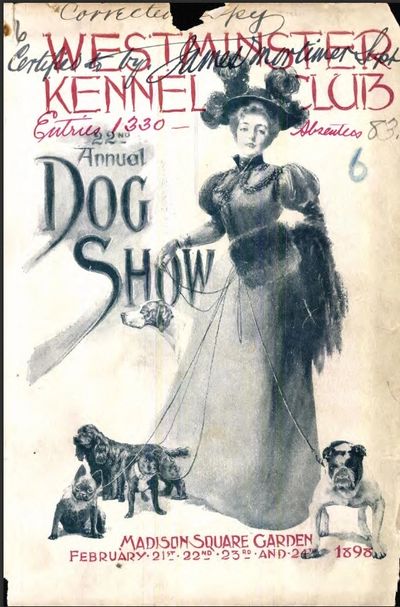
1898 Westminster Show Catalog featuring both ear types (bat AND rose eared).

"When a woman wants a thing she will have it, and that’s why the little, pure bred, ugly-looking ‘bulls’ are coming into vogue here and, as you say are going to ‘have their day.’ ” - M. Felix Fevre, early breeder and importer of French Bulldogs,
Not much is written in one place about Mr. Felix Fevre, one of the first competitors, breeders and early importers of the French Bulldog in the late 1890s and early 1900s. Mr. Fevre served as a committee member on the original FRENCH BOULEDOG CLUB, Founded by amateurs in 1898, Paris, (Recognized by the Société Centrale Canine.) So when we found this article in the New York Herald from 1904, it caught our attention.
You'll find the full article in it's entirety followed by full text where we've added complimentary historical photos from additional sources to put the words into context. Mr. Fevre has quite a bit of personality, as it turns out. Enjoy!

Noseless Face and Pugnacious Appearance Are Only Recent Innovations
"The Dollar Princess would have been set back behind straighter-faced dogs on the ground, that this extremely short face was neither typical of the breed nor a desirable property. It is with extreme regret I see the breed in danger of being spoiled by the advancement of this erroneous idea. Not only has harm been done by this departure from the true type, but the club has done still more harm by electing half the club judges from English bulldog men." - James Watson, Boston Post, 28 April 1912
Noseless Face and Pugnacious Appearance Are Only Recent Innovations
"The Dollar Princess would have been set back behind straighter-faced dogs on the ground, that this extremely short face was neither typical of the breed nor a desirable property. It is with extreme regret I see the breed in danger of being spoiled by the advancement of this erroneous idea. Not only has harm been done by this departure from the true type, but the club has done still more harm by electing half the club judges from English bulldog men." - James Watson, Boston Post, 28 April 1912

The French Bulldog of America catalogs for the Annual Specialty are full of wonderful, historical content of champions long forgotten as well as important breed standard verbiage that might surprise some who aren't aware of the original guidelines. The following content is brought to you from archives made possible by the AKC.

Many French Bulldog enthusiasts have no idea that the original French Bulldog standard set forth by the French Bulldog Club of America (FBDCA) allowed ALL colors in 1898. It wasn't until 1911 that a lace factory business tycoon, Samuel L. Goldenberg, petitioned the newly formed club in America to make certain colors and nose leathers a disqualification in the show ring.
But most never question WHY Mr. Goldenberg would be motivated to press for a show ring change, and what might be his agenda (yes... there is always an agenda). This video covers the details and timeline surrounding Mr. Goldenberg, his forced resignation from the Parent Club in France in 1911, and how he managed to make Mary Winthrop Turner's International Champion, winner of Westminster French Bulldogs in 1911, a DQ color in FBDCA. Without a vote. Behind Closed Doors. And just hours after hopping onto Lifeboat #5 from the Titanic... half empty... with the only surviving luggage on the Titanic. Be careful who you trust with big decisions...

This in-depth video takes you through over two hours of historical documents and evidence of the French Bulldog's history and origins as they were introduced to America in the Gilded Age, bringing the full color of this popular breed to light.
New evidence from AKC Stud books and archives from France have revealed the original, naturally occurring colors of the foundation French Bulldogs, and many of them were "Dark Iron Gray", including the Godfather of all modern French Bulldogs, Rabot de Beaubourg.

Her name was Margot de Pantin, born in 1903, imported from Paris, bred by foundation breeder, competitor, and Judge, Gabriel Billan.
Like MANY foundation French Bulldogs, Margot de Pantin was described by her breeders as "DARK IRON GRAY".
And she was the first documented dilute French Bulldog to earn her AKC Championship Title in 1908.

This chapter delves into the relatively recent origins of the French Bulldog breed (less than 100 years old at the time of publication in 1933), explaining how it was developed through crossings of old French dogs over the preceding seventy to eighty years.
According to Waldner Comminges' 1933 book "The French Bulldog: Its Origin, Its History, Its Breeding," the French Bulldog is a breed of relatively recent origin, emerging in the 19th century. While some accounts emphasize purely French creation in Paris, Comminges describes it as stemming from strains of the English Bulldog crossed with older French breeds, including the Mastiff, the Doguin (an extinct French dog related to mastiffs or catch dogs), and descendants of the ancient Alans (medieval hunting and guard dogs). These lineages trace back further to the Molossians of Epirus, an ancient Greek breed of large, powerful dogs used for guarding and warfare, which influenced many modern mastiff-type breeds. This cross-breeding occurred amid the Industrial Revolution, with English Toy Bulldogs being exported to France and refined by local breeders, particularly in Normandy, to create a smaller, companion-focused dog suited for urban life and vermin control. Comminges notes the breed's development over the preceding 70-80 years (from his perspective in the 1930s), emphasizing its manufactured nature through selective breeding rather than ancient purity.

Featuring an interview with Mr. Roger, this post examines the breeding practices and development of French Bulldogs in Paris during the early 20th century.

Discusses key breeding challenges, including difficulties with whelping and genetic surprises due to atavism, noting that out of one hundred French Bulldog puppies, certain unpredictable traits may emerge.

Provides observations from a visit to the Emerys' home, contributing to the broader narrative on the breed's origin, history, and breeding techniques in the 1930s.

Offers historical evidence, including a 1931 snippet from "L'Eleveur," about wire-haired and long-coated varieties, and details a breed standard update that mandated short coats.

Explores the controversies surrounding Samuel Goldenberg's forced resignation and the evolution of the French Bulldog breed standard, with insights into historical interpretations and changes.
In April 1895, one of the early importers of French Bulldogs into America, Mr. J. W. "Thomas" Lawson of Winchester Massachusetts, made headlines in the papers for his French Bulldog, "J. Fros", also sometimes referred to in documents as "J. Fross".
Mr. Lawson imported J’Fros, one of the first of his breed in America at the time, and entered him into the Boston Terrier and the Miscellaneous classes of the 1895 New England Annual Dog Show because there wasn’t yet a category for his breed.
The newspapers wrote about him, discussing how he looked a lot like a Boston Terrier.
It was perhaps this “trial” show that triggered the Americans to separate Boston Terriers from French Bulldogs, giving them their own platform to be judged.

Who Wants to Know Something (More) About Mary?
We thought you would enjoy these little-viewed articles and photos about one of the most famous, accomplished (and young) female breeders of original French Bulldogs, Mrs. Mary Winthrop Turner, complete with juicy Guilded Age Scandals.
This runaway orphan, nun, actress, published editor, and extremely accomplished competitor, breeder, and judge of French Bulldogs at the height of their popularity was one of the most influential people in this breed's history.
And does she ever have the story to tell at a time when women did not even have the right to vote, let alone challenge the most powerful men in the world?
While the FBDCA lists "Cream" as a standard color, what very few modern breeders realize is that "Cream" was not an original color for the French Bulldog, making its first verified appearances in the AKC Stud books in 1931, a full 34 years after the breed was created.
While genetic cream is recessive, meaning it takes two copies inherited from each parent to express, this gene is different than the others of its time, and not just because it is epistatic in expression.
The key difference is that other recessive genes, such Dilute, Cocoa, and Tan (also recessive) were VERY well documented in the French Bulldog gene pool with registrations for each as early as 1900.

"Everyone who knew the history of the dogs to be judged was anxious to see how Miss Winthrop's decisions would compare with those made in previous shows and a few of the men present who believe a woman cannot have an unbiased opinion declared Miss Winthrop would not choose Gamin's Riquet to wear the blue". - Excerpt from the New York Times 12/3/1911
No wonder those Good Ol’ Boys hated her. Every time I think I have Mary pegged, she changes shape.

Ever wonder how the Dilute (d) gene was introduced into the French Bulldog population? According to some, it is only a recent outcross, and that any French Bulldog, regardless of registration or pedigree, MUST be a "mutt" if they carry or express the Dilute (d) gene.
Those minority few are wrong.

In early 1911, one of the most celebrated and famous people behind this breed's history in America, Mary Winthrop Turner, purposefully CHANGED the AKC registrations of her most famous upcoming show dogs to list them as "dark brindle" instead of their previous colors, including "gray brindle".
At first, it looked like a typo because we already had the documented registration from the first volume. It wasn't until later that the updated registration was discovered in a later volume. Why would she do that? That's a VERY good question... one that begs proper investigation.